|
new version posted 2012 October 14
Hakamada Iwao's appalling
imprisonment — information condensed from Amnesty International
documents (website, the Individuals at Risk portfolio, greeting-card
actions, and new mailings in 2011, 2 012 and 2013)
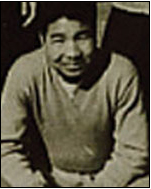 Hakamada
Iwao, 77 on 10 March 2013, is the world's longest-serving death row
prisoner: 47 years. Hakamada
Iwao, 77 on 10 March 2013, is the world's longest-serving death row
prisoner: 47 years.
He was arrested in 1966 for the murder
of his employer, his employer's wife, and their two children.
Held in a police cell, he was intensively
interrogated for 20 days under a system called daiyo kangoku (“substitute
prison”). During this time there are no rules controlling the
length of interrogations, which last up to 12 hours a day; sessions
are not recorded; no lawyers are present. Amnesty International has
documented methods routinely used to obtain “confessions,”
including intimidation, beatings, sleep deprivation, questioning from
early morning till late at night, and making the suspect stand or
sit in a fixed position for long periods. At his trial Hakamade said
he was beaten and threatened by police officers to force him into
signing the confession. He has repudiated it ever since, maintaining
his innocence.
Used as evidence at the trial was a
set of bloodstained clothing, found in a tank at the factory where
he worked. The clothing was too small for him. The prosecution claimed
it had shrunk in the tank. The knife he was supposed to have used
was, according to his lawyer, too small to have made the fatal wounds.
And the door by which he was alleged to have entered and left the
victims' house had been locked.
In 1968 he was convicted and sentenced
to death, primarily on the basis of the forced confession.
Lawyers have made several unsuccessful
appeals to the higher courts.
The principal judge presiding at the
original trial, Kumamoto Norimichi, has publicly stated that he believed,
even then, that Hakamada was innocent. In testimony to the UN he said:
“I could not convince the other two judges that Hakamada was
not guilty so I had to convict him as the decision was made by the
majority . . . I pray for his exoneration every
day.”
This judge joined the campaign to get
Hakamada freed: www.protectthehuman.com/videos/-i-had-to-sentence-an-innocent-man
British Liberal Democrat MP Alastair
Carmichael has worked on the case with Amnesty International, made
a trip to Japan, and commented (on the Amnesty Blog website): “I
have never come across a campaign before claiming a miscarriage of
justice where the campaign included one of the trial judges!”
Waiting to be hanged for more than forty years, could be hanged
tomorrow
Execution in Japan is by hanging. After
appeals are exhausted, a prisoner may wait years or decades for this.
Yet could be executed at any time. He is notified only on the morning
of the day he is to die. It is done in secret. The family is informed
only afterward.
The Ministry of Justice claimed this
secrecy protects the family of the prisoner from shame, even that
it reduces mental strain on the prisoner. It does the opposite: the
prisoner lives year after year in unremitting fear of imminent hanging.
Driven mad
Hakamada has spent 28 of the years of his imprisonment in solitary
confinement
Prison governors and wardens have wide
discretion to set their own rules, and these rules are kept secret.
Death row inmates are not allowed to talk with other prisoners, nor
to engage in hobbies or other interests, nor watch television. Visits
from family and lawyers are at the discretion of the governor. Rules
control how many letters a prisoner may write, when he may go to the
toilet, even the way he is expected to walk.
No wonder that Hakamada has become mentally
ill. After his sister requested a re-trial, a psychiatric review was
made by Dr Nakajima, who found that Hakamada's condition amounted
to a “state of insanity,” he could not maintain a conversation,
had megalomania, had lost understanding of what execution meant, needed
hospital treatment, was not competent to petition for a re-trial,
or indeed to be executed.
This allowed his family to petition
in his stead for a re-trial, which his sister did, but re-trial was
again turned down. His sister believes that a re-trial would lead
to his release.
International law clearly prohibits
the execution of the mentally ill. Japan's own Criminal Code gives
the Minister of Justice the power and responsibility to stay an execution
“if a person condemned to death is in a state of insanity.”
In 1998 the UN Human Rights Committee
found that prison conditions for death row inmates in Japan were incompatible
with the International Covenant on Civil and Political Rights, ratified
by Japan in 1979.
Cautious hope
The death penalty has wide support in Japan. This is at least partly
due to the extraordinary secrecy that shrouds it from view. People
do not have to think about it, and there is little information for
potential public debate.
The government showed some openness
to public debate on the death penalty. Minister of Justice Eda Satsuki
declared at a press conference on 21 January 2011 that it was time
for Japan to consider abolition.
Late in 2011 the Shizuoka District Court
commissioned experts from the prosecution and defence to carry out
a series of new forensic tests - DNA tests - on the clothing Hakamada
was alleged to have worn at the crime. The court examined this evidence
from October 2012 to January 2013. It is reported that the new evidence
casts doubt on Hakamada's conviction. The court is expected to make
a ruling on whether to grant a re-trial, but has asked the prosecution
and defence yet for more information, and is expected to announce
its decision in April 2013 at the earliest..
However, in December 2012Japan got a new government, the new Minister
of Justice supports the death penalty, and by March 2013 there were
three executions.
|